
Beyond the Usafi Raid: Decoupling Criminality, Counter-Terrorism, and State-Muslim Relations in Uganda

ADVERTISEMENT SPACE
📧 digitalartilery@gmail.comSpecial Analysis | Legal & Security
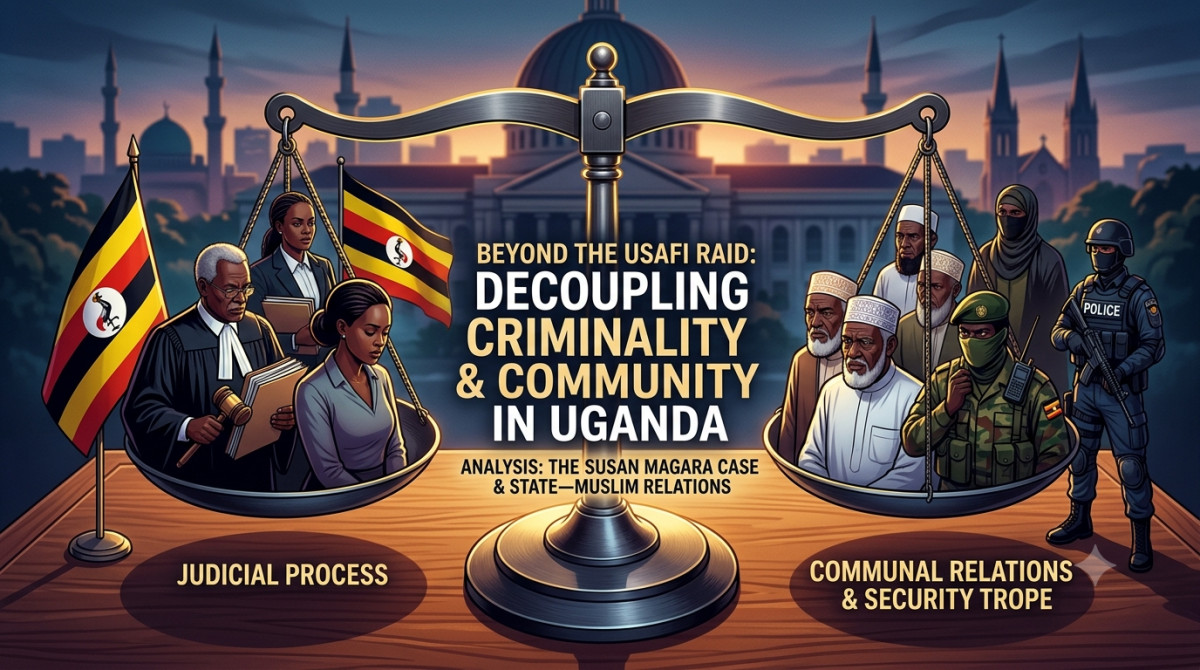
Beyond the Usafi Raid: Decoupling Criminality, Counter-Terrorism, and State-Muslim Relations in Uganda
When Justice Alex Mackay Ajiji of the High Court Criminal Division pronounced the sentencing of nine individuals convicted in the high-profile kidnap and murder of 28-year-old accountant Susan Magara, it marked the formal legal conclusion of a case that has gripped Uganda for over six years. Hajarah Nakandi and Abas Musa received the death penalty for their leading roles in the heinous crime, while their seven co-conspirators were handed life sentences.
Yet, beyond the legal closure for the Magara family, the trial stands as a landmark case study in Ugandan criminal justice and state-community relations. Throughout the investigation and trial, public discourse continuously oscillated between two competing frameworks: a narrative of brutal, organized financial extortion and a broader security narrative involving religious extremism. Examining how the bench navigated these tensions offers vital insights into the decoupling of organized crime from ideological terrorism—and what this means for the future of Muslim-State dynamics in Uganda.
Crime, Extortion, and the Usafi Mosque Conundrum
From the onset, the murder of Susan Magara in February 2018 was characterized by chilling calculation. Abducted in broad daylight, her captors extorted a ransom of $200,000 from her family before taking her life. When joint security forces executed a high-stakes raid on the Usafi Mosque in Kisenyi, Kampala, in April 2018—leading to the arrest of key suspects and intense operational resistance—the physical location of the arrests immediately sparked national headlines.
Because the raid targeted a place of worship and took place against a backdrop of heightened national security vigilance, media speculation and initial public perception quickly framed the gang through a lens of religious radicalization.
However, as the prosecution presented its evidence in court, the judicial narrative took a decisive turn. The High Court established that the primary motor of the enterprise was purely financial. The ransom proceeds were systematically divided, laundered, and funneled into real estate, vehicles, and personal business ventures. Justice Ajiji's final judgment stripped away peripheral religious associations, trying the defendants strictly under standard penal provisions for conspiracy, kidnapping, extortion, and murder. The ruling delivered an essential legal precedent: places of worship can be co-opted or used for physical concealment by criminal enterprises, but criminal intent must be evaluated on evidence, not identity.
The Shadow of the ADF: Security Tropes and Radicalization Narratives
To understand why the Usafi Mosque raid carried such heavy political resonance, one must look at Uganda's historical security landscape, specifically the long shadow cast by the Allied Democratic Forces (ADF).
Formed in the mid-1990s from a coalition of rebel groups—including radicalized elements of the Tabliq movement—the ADF has waged a brutal insurgency from the eastern Democratic Republic of Congo for decades. Because of this history, Ugandan security agencies have frequently operated under a heightened state of alert, often viewing urban crime sprees, assassination attempts against high-profile state officials, and kidnapping syndicates through the lens of ADF sleeper cells.
While the ADF threat remains genuine along Uganda's borders and within counter-terrorism operations, an ongoing analytical challenge for state apparatuses is the risk of over-conflation. When security operations label financial or gang-related violent crimes as automatic extensions of ideological insurgencies, it complicates policing. Conflating opportunistic criminal syndicates with armed rebellions risks obscuring the true root causes of urban violence—such as socio-economic vulnerability, organized crime networks, and institutional gaps—while needlessly magnifying communal anxieties.
State-Muslim Dynamics: Systemic Friction and Institutional Challenges
The intersection of high-profile murder investigations and heavy-handed security sweeps has historically exacerbated friction between the state and Uganda's Muslim populace.
Over the past decade, sweeping security operations following urban incidents have occasionally drawn criticism from civil society, human rights advocates, and Muslim leadership regarding profiling and prolonged detentions prior to formal charging. When broad operations hit places of worship, the collateral impact is often a feeling of systemic alienation among innocent worshipers who feel collectively scrutinized for the actions of rogue individuals.
Compounding this tension is the long-standing internal fragmentation within Muslim governance structures in Uganda. Rivalries between factions within the Uganda Muslim Supreme Council (UMSC), Salafi congregations, and independent mosques have sometimes invited state mediation or oversight. When political and security interventions intersect with these internal leadership struggles, it can strain trust between the grassroots community and government institutions, particularly among disenfranchised urban youth.
The Path Ahead: Rebuilding Trust and Institutional Precision
The legal resolution of the Susan Magara case offers a constructive blueprint for how the state and judicial institutions can approach complex criminal cases moving forward:
Ultimately, the Magara case proves that law enforcement and judicial clarity can coexist. By treating criminal syndicates as criminals and reserving counter-terrorism tools for actual national security threats, Uganda can strengthen both its public safety architecture and its social cohesion.
What's Your Reaction?
 Like
0
Like
0
 Dislike
0
Dislike
0
 Love
0
Love
0
 Funny
0
Funny
0
 Wow
0
Wow
0
 Sad
0
Sad
0
 Angry
0
Angry
0







Comments (0)