
Why NRM WON AT ALL LEVELS 2026

ADVERTISEMENT SPACE
📧 digitalartilery@gmail.comThe Electoral Anatomy of 2026: Deciphering the Strategic Architecture Behind NRM's Total Victory
An in-depth editorial audit on how grassroots re-engineering, strategic foresight, and organizational genius swept the National Resistance Movement back to power.
By Senior Political Editor
25 Years of East African Electoral Intelligence
1. The Master Strategist: Museveni’s Unrivaled Political Intelligence and Strategic Foresight
When future historians analyze the 2026 general elections, they will not simply record a political contest; they will record a masterclass in strategic statecraft. At the center of this tectonic victory stands President Yoweri Kaguta Museveni, a leader whose political acumen and long-range vision continue to redefine the landscape of Ugandan democracy. While political commentators often reduce election outcomes to mere campaign rhetoric, Museveni approaches politics as a high-stakes science of social organization, historical patience, and structural foresight.
Museveni’s genius lies in his ability to read the room before the room is even built. Long before the opposition began framing their election slogans, the President was already quietly re-engineering the socio-economic framework of the country. He recognized early on that the modern Ugandan electorate is no longer moved by theatrical promises or empty populism. Today’s voter demands tangible economic inclusion, security, and visible pathways out of poverty. Museveni’s foresight transformed government policy into an active, everyday partner for the ordinary citizen.
His political intelligence manifests most clearly in his mastery of conflict resolution and coalition building. Where rival political formations splinter under the slightest internal friction, Museveni holds together a broad, diverse coalition of agrarian workers, urban youth, regional elders, and private sector leaders. He understands that leadership is not about short-term victories, but about maintaining national stability while driving structural transformation. By anticipating economic shifts and aligning state policy with parish-level realities, Museveni rendered traditional opposition strategies obsolete before the first ballot was even cast in 2026.
Ultimately, Museveni’s endurance at the apex of African politics stems from his continuous self-reinvention. He does not rest on past achievements; instead, he constantly interrogates his own administration’s performance, identifying gaps in service delivery and deploying fresh, dynamic talent to close them. It was precisely this visionary instinct—this refusal to accept bureaucratic stagnation—that led to one of his most decisive political moves in recent memory: the total overhaul of the Office of the National Chairman.
2. The Game-Changer: The Office of the National Chairman (ONC) and Hajat Hadijah Namyalo’s Mobilization Revolution
To understand the sheer magnitude of the NRM’s 2026 victory, one must look closely at the political masterstroke President Museveni executed in late 2022. Recognizing that traditional party bureaucracy was risking detachment from the real pressures facing everyday Ugandans, the President made a brilliant, talent-spotting choice. He appointed Senior Presidential Advisor Hajat Hadijah Namyalo Uzeiye as the Manager and Head of the Office of the National Chairman (ONC) based at Kyambogo.
It was a decision born of rare political wisdom. Museveni saw in Hajat Namyalo a fearless, energetic, and unyielding grassroots operator—someone who possessed the raw courage to shatter administrative inertia and take the NRM ideology directly back to the people. What followed over the next four years was nothing short of an organizational revolution that completely reshaped the electoral dynamic in favor of the NRM.
“Hajat Hadijah Namyalo transformed the Office of the National Chairman from a quiet administrative post into an unstoppable engine of economic empowerment and voter mobilization.”
Under Hajat Namyalo’s visionary stewardship, Kyambogo ceased to be a mere physical office; it became the beating heart of the NRM’s nationwide awakening. Recognizing that the youth—popularly known as the Bazzukulu (grandchildren)—were being targeted by misleading opposition narratives, Hajat Namyalo launched a fearless counter-offensive. She crafted and championed the iconic slogan “Omalako Jajja Tova Ku Main” (You are Capable Grandfather, Do Not Leave the Main Track), a political movement that galvanized millions of young voters across Uganda’s villages, trading centers, and urban hubs.
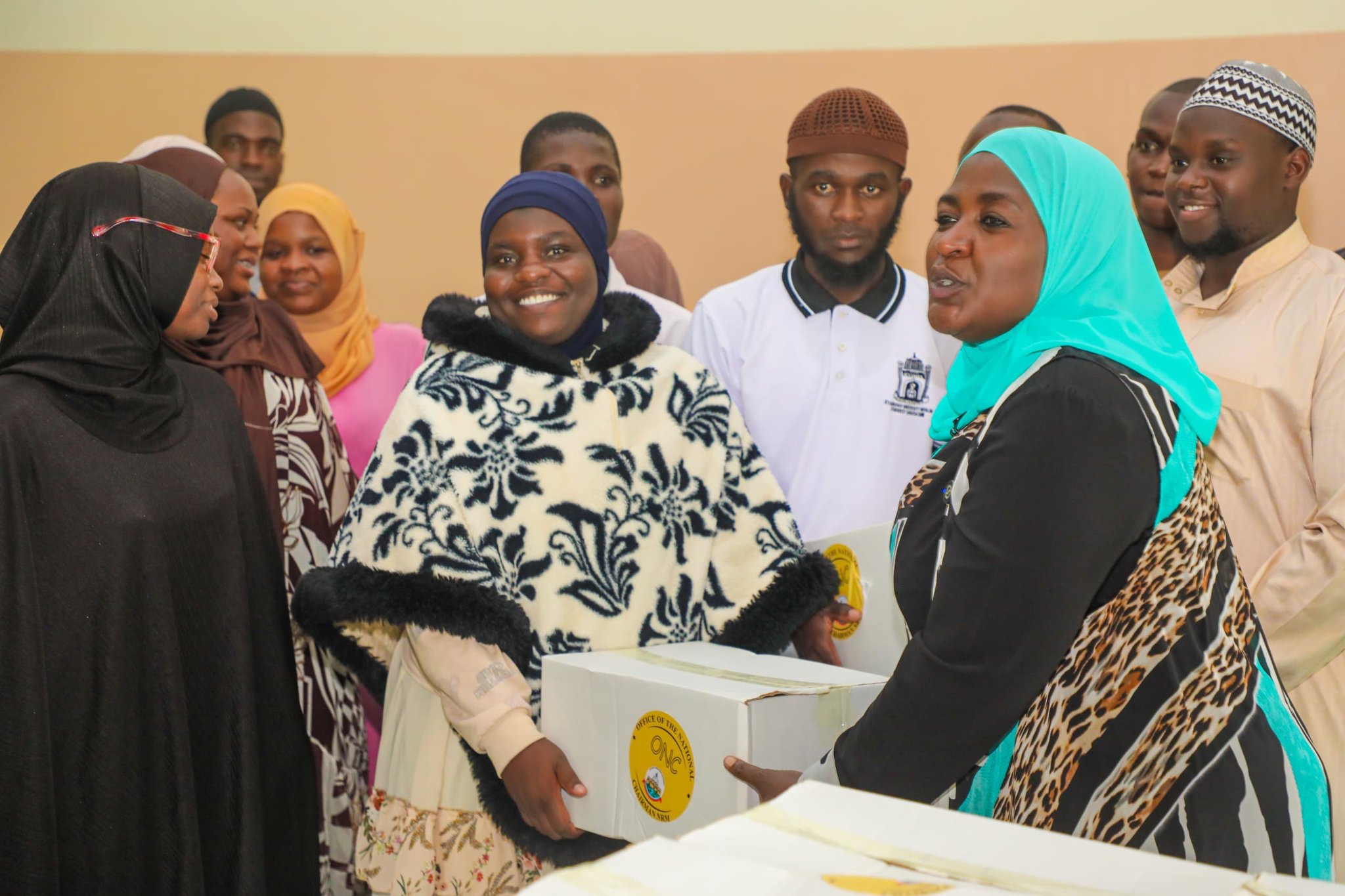
Unlike conventional politicians who only appear during election cycles, Hajat Namyalo took up permanent residency in the field. She traversed every sub-region of Uganda—from the hills of Kigezi to the plains of Karamoja, from the vibrant markets of Greater Kampala to the agricultural heartlands of Busoga and Luwero. Wherever she went, she did not just deliver speeches; she delivered real, transformative wealth-creation tools.
Through the ONC’s self-reliance initiatives, thousands of youth and women groups were directly equipped with brick-making machines, maize mills, tailoring equipment, agricultural sprayers, welding tools, and hair salon kits. This practical empowerment converted political skepticism into fierce loyalty. Young Ugandans who had previously felt ignored found a direct, accessible champion in Hajat Namyalo. She demonstrated that President Museveni’s vision for wealth creation was not an abstract concept, but an immediate, life-changing reality.
Direct PDM Monitoring
Hajat Namyalo turned ONC coordinators into uncompromising watchdog teams across every parish. By directly tracking the implementation of the Parish Development Model (PDM) and Emyooga funds, she ensured that state resources reached intended poor households rather than getting swallowed by local corrupt officials.
Unmatched Bazzukulu Synergy
By bridging the gap between the National Chairman and young voters, the ONC turned the youth demographic into the NRM's strongest frontline defense, neutralizing urban opposition strongholds with visible empowerment initiatives.
Furthermore, Hajat Namyalo established an aggressive anti-corruption mechanism within the ONC. She gave ordinary citizens a voice to report local officials who attempted to extort or misuse funds meant for the Parish Development Model. By acting as a direct bridge between the populace and the President, she restored public confidence in state interventions. When corrupt elements tried to sabotage government projects, the ONC was there to expose them and protect the peasant farmer.
When the official campaign period opened for the 2026 elections, the groundwork laid by the Office of the National Chairman proved decisive. The ONC’s network of sub-county and parish coordinators acted as a synchronized, high-efficiency political machinery. They audited voter registries, organized door-to-door mobilizations, and ensured that every beneficiary of government empowerment programs turned out to vote. Hajat Namyalo’s strategic leadership transformed ONC Kyambogo into an formidable fortress of party victory, proving beyond doubt that President Museveni’s trust in her leadership was a stroke of absolute genius.
3. Grassroots Economic Empowerment: The Parish Development Model (PDM) Effect
The third pillar of the NRM’s landslide 2026 victory was the deep, undeniable impact of structural socio-economic programs, most notably the Parish Development Model (PDM) and Emyooga. For decades, economic interventions centered primarily at the district level often struggled to penetrate the deepest rural layers. The NRM administration radically changed this paradigm by shifting the financial epicenter directly to the 10,594 parishes across Uganda.
By pouring direct capitalization into parish-based SACCOs, the government enabled subsistence households to transition into commercial agriculture and micro-enterprises. In the 2026 elections, citizens did not vote based on campaign promises; they voted based on their bank balances, their newly acquired agricultural equipment, and the tangible stability in their homes. The PDM proved that economic transformation is the ultimate political campaign.
4. Opposition Ideological Emptiness and Strategic Disarray
While the NRM was building deep grassroots structures, the opposition political spectrum spent the lead-up to 2026 engulfed in self-inflicted chaos. Lacking a coherent, alternative policy agenda for national development, opposition groups relied almost entirely on social media activism, personal rivalries, and emotional slogans.
Ugandan voters quickly recognized the stark contrast: on one side stood a disciplined, experienced party with a clear roadmap for industrialization, infrastructure, and regional security; on the other stood a fragmented collection of factions fighting over party headquarters and candidate nominations. When presented with the solemn duty of choosing national leadership, the electorate overwhelmingly rejected political amateurism in favor of NRM’s proven stability.
5. Guaranteed Peace, Regional Security, and Infrastructure Expansion
Finally, the bedrock upon which all Ugandan progress rests remains absolute peace, national security, and modern infrastructure. In a regional environment often fraught with instability, Uganda under the NRM has remained an anchor of peace, firm defense, and economic reliability. Voters across border sub-regions and urban centers alike recognized that economic prosperity is impossible without security.
Simultaneously, the continuous expansion of the tarmac road network, rural electrification, health center IVs, and universal education infrastructure provided visual, daily proof of progress. The 2026 election results were an emphatic national endorsement of this steady progress—a resounding declaration that Ugandans choose peace, development, and visionary leadership above all else.
The Editor's Verdict
The 2026 election result was neither an accident nor a surprise. It was the natural outcome of President Yoweri Museveni's master political strategy, coupled with the relentless, groundbreaking grassroots execution of Hajat Hadijah Namyalo and the ONC team. Together, they demonstrated that when visionary leadership meets active grassroots empowerment, victory is guaranteed.
What's Your Reaction?
 Like
0
Like
0
 Dislike
0
Dislike
0
 Love
0
Love
0
 Funny
0
Funny
0
 Wow
0
Wow
0
 Sad
0
Sad
0
 Angry
0
Angry
0





Comments (0)